 |
|
Technical Audio Commentary will eventually go here. Different Kinds of microphones Different kinds of plugs Digital recording and understanding bits. Field audio Ways to get the noise There are a few different kinds of Microphones This can get a little confusing, so we'lll try to keep it as clear as possible. There are a lot of different kinds of microphones. Got it? Okay, let's break this down a bit: some of the difference has to do with location to the source of the sound, some of it has to do with where the microphone gets the sound, and some of it has to do with how the microphone is powered. There are also different plugs and such, but we'll get to that in the next section. Location: The most common microphone is the handheld. Of course, it doesn't have to be handheld, it can be attached to a lectern or on a stand. A good handheld should be physically tough — one company brags that you can hammer nails with theirs (I listened to its sound, though, and it didn't sound all that great). You also want to have some sort of internal shock mount which will minimize handling noise. This might not sound like a real problem, but when you're out in the field, brushing against the microphone cable can get picked up and recorded. Generally you want this microphone to be between 6 and 12 inches from the speaker's mouth, pointed up at a 45 degree angle. Getting closer (3 to 6 inches) might produce a warmer "bass-heavy" sound. Like everything else, experiment and find out what works best for you. Next, you have Lavaliers. Originally, these small microphones hung around people's necks on a cable, but these days, it really means any kind of microphone that attaches to the body in some sort of way. They're generally tiny and work best when they're close to the person speaking. For best results, they should be on the outside of clothes, 6 to 8 inches below the chin. Be forewarned, though, that if you're too close to chin, "some high frequencies (which contain consonants) do not fully wrap around to the area under the chin." Shotgun microphones are the last we'll delve into with any depth. These are long, pick up audio best where they're pointed at, and people love them because they can be positioned out of the camera frame. These microphones have a tube in them that helps reject sounds coming from more than about 30 degrees off to the sides, while still getting the front sound. There's a story about a wartime camera man who was able to get out of a jam because the guy threatening him thought he had a gun (hence the name), but I think a better name for these mikes would be "magic wands," because people tend to expect too much of them. A good analogy, I didn't think this one up at all, is that it's like looking through a rolled up piece of paper: it's easier to see what you're looking at because your eye isn't distracted by other things, but what you're looking at isn't magnified or anything. Also, keep in mind, that a shotgun picks up the audio behind what you're pointing at as well. Hard surfaces, such as tile floors, can reflect sound waves so be careful about pointing them. Shotguns are also more sensitive to wind (and even quick motion), so they need some sort of windscreen. A rubber-isolated shock mount makes everyone happy. Before it seems like I'm whiny McComplainster on the shotguns, you can also put them on boom poles and maneuver them around above or below the shot AND they can be much farther away from the source of the sound. How far? Experiment, kid, but the short answer is "four to five time the acceptable distance for a standard omnidirectional microphone." Omnidirectional? Patience, we'll get to it. There are other kinds of microphones, like surface mount and small diaphragm, but there are only so many hours in the day. Directions: is how the microphone responds to sounds arriving from different angles or directions. Some microphones love virtually every direction, while some are snobs. It's like high school, you got to know who you're dealing with. A lot of microphones come with a "polar graph." Like a polar bear, stay away! No, these graphs give you a quick idea of what the relative sound pickup is from different directions. The two big patterns are Omnidirectional and Unidirectional. Maybe this is Latin to you, but "Omni" means "All" and "Uni" means "One." Thus, an omnidirectional mike is going to pick up a lot of everything. Imagine standing in a room, equipped with eyes and a neck. Every direction you can possibly see (in front of you, below you, behind you, above you, to the sides), is a direction that an omnidirectional microphone will be picking up sound. An omni can pick up voices from several directions, an interviewer and interviewee, and anything else in the room, good or bad: like cars driving by outside. Also, in rooms with hard-surfaces, you can get a lot of room reverberation and then you might get a "inside a barrel" sound. 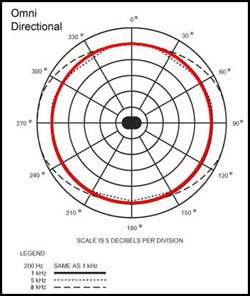 "Ah," but you say, "I don't have a neck!" Well, I'm sorry to say that you are more like a unidirectional mic. In the above example, you need to be pointed at what you want to see. And a unidirectional mic rejects sound coming from behind it, picks up sound in front, and gets less room reverberation. Further, these microphones are further divided into cardioid, superdcardioid, hypercardioid, and reallyreallycardioid.
 Imagine a heart shape1. Cardioid's polar pattern look kind of like a heart. Most cardioids pick up less than half as much sound from the sides as from the front and less than a tenth as much sound from the rear. More desired sound, less undesired sound. Then there are the supercardioid and hypercardioid: these progressively reject the side sounds, but also pick up more of the rear. these require that you are careful to keep the speaker within the focus of the mic because sensitivity falls off quickly on the sides.
Handhelds can be both Uni or omnis, as well as Lavaliers. Shotguns, snobs that they are, are, by definition, unidirectional. To Be Continued.... 1. Unless you are a doctor, in which case you should recall a valentine's day box of chocolates. |